Showing posts with label John. Show all posts

Tuesday, February 17, 2015

The jitney problem...


A jitney bus about 1924. Image from Wisconsin Historical Society.

One memory that stands out for me from when we lived in Manila, was the jeepney busses (similar to jitneys) that drove around the city, with all the bright colors and decorations, which included fringe and beads hanging from the windows. They were pretty cool to watch, especially when you are a kid.

Who would have thought that my grandfather would have been part of the jitney craze that hit America in the nineteen teens and continued until about 1923.

The jitney business, (according to a 1915 article I found1), is said to have originated in the southwest, due to the recession which broke out just after WWI, and is believed to have started because of a street car service strike. An intrepid businessman seeing folks in need, took the opportunity to make a few extra nickels in a poor economy by charging them for a ride in his automobile. They were called ‘jitneys' because they cost a nickel to ride, and slang for a nickel at the time was ‘jitney'.

This idea took hold like wildfire, spreading across the country with great enthusiasm. It apparently also caused massive headaches for local city councils who were wholly unprepared for the problems this craze would cause. Problems like congestion and increased street accidents. Local trolley lines and chartered transportation companies began losing money as a very fast clip as fewer folks were using their systems. City officials and public utility commissioners were now tasked with the necessity of regulating the 'rampant individualism’ that was causing such havoc on their streets.

Fleets of automobiles were appearing unexpectedly on local streets and not conforming to any regulations. Anyone who was unemployed, wanted to change jobs, had an automobile, regardless of skill or experience, was getting into the business. Street accidents became frequent due to congestion, defective automobiles, reckless driving, and competition amongst drivers.

The railroads, trolley lines and taxi companies with franchises to protect, were all solidly against the jitney. In some cities councils, sensitive to the 'established order' of their towns attempted to legislate the jitney out of business. One way this would work was to make jitney owners responsible for any accidents they are involved in.

Wisconsin newspaper article talking about one of the reasons jitneys were starting to die out at this time,
they were becoming too expensive to run.

Some of the advantages of the jitney as opposed to the other modes of transportation available to folks were: quicker service, a more comfortable and cleaner ride, cheaper, and not as noisy. Jitneys could provide service to suburban and interurban areas. Transportation strikes would never affect the drivers, they weren’t in a union. They also helped make a city prettier by eliminating the need for trolley poles and lines. The nickels spent for the ride generally stayed local. And, hey, chauffeur!

The jitney definitely made big business sit up and take notice, their strap-hanging public had an alternate mode of transportation and were using it.

I have no idea how long Clarence ran his business or where in Wisconsin this happened. But I am sure hoping that I can find out.

The craze had many a song written about it.
1 The Jitney Bus Problem, by E. S. Koelker, page 87; The Wisconsin Municipality, volume XV, January to December, 1915; Madison, Wisconsin.


Wednesday, February 4, 2015

What about the ex...

A case of researching the ex-spouse to solve a mystery.

I have known that my paternal Grandfather Clarence John had been married previous to my Grandmother Myrtle for many years. I even knew that they had had a daughter together. But it wasn’t until a few years ago that I was able to find the name of his first wife, which happened while I was going through newspaper articles from Forest County, Wisconsin. In the paper was the announcement that Clarence had married in Illinois to Esther Edwards. (My father had at one time known her name, which he had found out when an uncle of his died and she or her daughter was mentioned as a beneficiary, but over time he had forgotten it.)

For my father, finding out that Clarence had a wife previous to his own mother, Myrtle, was quite a big shock, as was the fact that he had a half-sister he never met! Clarence had done a pretty good job of keeping it a very closely guarded secret from his own children, but everyone else in the family knew her and their daughter, and had even kept in touch with them over the years.

The big questions I wanted to answer were: when did this first marriage end, and where? To do this I first needed to find out more about Esther, because research on Clarence hadn't helped. During earlier research attempting to pin down when they might have been divorced, I had found her in 1930 living with her father and Marie (the half-sister) in White Lake. The census did indicate she was divorced, but, I still didn’t know where or when. I had tried to find a divorce for them in Forest County, but no luck. I decided to continue the search further ahead in time, so I went to the 1940 census. Bingo! There she was in White Lake, with Marie, only now she is married to an Oscar Christenson and they have two daughters of their own. This was excellent news, because, usually, on these later marriage records there is a question regarding any previous marriages. As my niece lives in Antigo I asked her to drop by the register of deeds office and see if she could find the marriage in question. A few days and a text later, there it was in black and white: previously married to Clarence John, divorced October 28, 1923 in Merrill, Lincoln County, Wisconsin, the answer to both of my questions. Now I could also breath a sigh of relief, because my grandfather had definitely not been married when he met my grandmother.

Marriage certificate for Esther and Oscar.


But of course it didn't stop there. My first thought was, “Wow, only married a year and a half-ish. What went wrong?” The clerk of courts in Lincoln county informed me that they had divorce records from 1926 and on a little late for me. So I searched ArCat (the Wisconsin Historical Society Archives Catalog) then contacted the UW Stevens Point Area Research Center, (which holds records from Lincoln County) and asked them to sent me the case file for Clarence and Esther John/s from Lincoln County. Four days later it arrived.

The file isn’t big. Probably because Clarence never showed up in court to contest the petition or testify, even though he had been summoned to do so.

Here is the complaint:

Esther E. John vs. Clarence John
1. That she and the defendant were married at Waukegan, Ill., on January 10th, 1922; that she has been a resident of the State of Wisconsin all her life. 
2. That there has been born as the issue of said marriage, one child, a girl, named Gertrude Marie; that said child is now nine months of age. 
3. That beginning shortly after said marriage the defendant began a course of cruel and inhuman treatment towards this plaintiff and that some of his acts are as follows: That three months after said marriage he struck her in the face with his fist and caused her to have a black eye; that he repeatedly struck her ['and kicked her' is marked out]; that he has sworn at her frequently and called her indecent names and accused her of infidelity and has slandered her by telling untrue and indecent things about her character.
      That ever since said marriage, the parties hereto made their home with the parents of the plaintiff on an agreement that defendant was to pay one-half of the expenses of running the household and furnish the wood; that he failed to carry out this agreement; that he failed to provide her with sufficient money to support herself and said child and she was obliged to look to her father and mother for sufficient funds wherewith to maintain and clothe herself and said child and was also obliged to use a part of her savings which were on deposit in the bank at White Lake, Wis; that she had an edowment insurance policy made payable to him on which a premium became due shortly after said marriage and he refused to pay the same and she was obliged to pay it out of her savings; that at Christmas time, 1922, he gave her no money wherewith to purchase necessitites for any Christmas remembrances and she was obliged to use her own funds for such purpose; that shortly before March 1st, 1923, he was abusing her and continued the same for a period of about one week, ['when he left home and she did not know his whereabouts for two or three days' - lined out] and finally on March 1st, 1923, he left her and they have not lived together as husband and wife since said date; that he is lazy and when he does get work, he cannot hold a job on account thereof; that a part of the time he runs a Jitney line; that after March 1st, about May 1st, she was obliged to enter a hospital in Antigo on account of sickness and previous to that during March and April while she was sick at home he did not call on her or see her or inquire about her condition, so far as plaintiff knows, and saw her only once during all of the time she was in said hospital; that he refused to pay her doctor bill or store bill or hospital bill until compelled to pay the doctor’s bill by law, and she was obliged to pay the store account and nurses’ bill and paid $70.00 hospital bill for the time she was in said hospital at Antigo.

4. That defendant is a strong and able bodied man and has earned at common labor, $3.50 per day and while in his Jitney business earned at least $5.00 per day net; that plaintiff has had some training as a clerk and stenographer and is capable of earning good wages but on account of her recent sickness will not be able to secure a position for a period of about six months; that she has, at all times, kept her marriage vows; that since his desertion of her, on March 1st [1923], she has been obliged to  a part of the time, pay for the care of said child; that she has not sufficient money or means of her own wherewith to carry on this action or support said child.
5. That plaintiff’s maiden name was Esther E. Edwards; that no prior action of divorce has been commenced or is now pending between the parties hereto.
     WHEREFORE, plaintiff demands judgment for a divorce from the bonds of matrimoney existing between her and the defendant; for custody of said child; that defendant be required to pay the attorney’s fees and costs in this action and provide a suitable amount weekly, for the support of said child; to repay her the $70.00 which she paid the Antigo hospital; for the restoration of her maiden name and for such other and further relief as may be just. (here is the whole case file in pdf)
The divorce was granted on October 24th (not 28th as Esther indicated on her marriage certificate, a minor quibble). They weren't officially divorced until a year after that date though.

Esther and Clarence were married in early January of 1922. Gertrude Marie was born in early August of 1922. Which means that Esther could quite possibly have been pregnant when they married. I do not know if Marie was premature, by about a month, or not. So, if they did marry because she was pregnant, it is quite possible that they married for the usual wrong reasons, and as so often happens in these cases, it didn’t work out for them.

I have a hard time believing that my Grandfather would behave in such a manner. Granted, I never knew him. But nothing I had ever heard about him indicated he would commit these kinds of acts.  However, one has to remember when reading this testimony that before the advent of no-fault divorce in the United States, a divorce could only be obtained by showing one party to be at fault in the marriage. It meant that one spouse had to plead that the other had: committed adultery, abandoned the family, or (one I have seen in many divorce cases in my years at the archives), committed cruel and inhuman acts, which usually included physical, mental and verbal abuse, even if none of this occurred during the marriage. Many American lawyers and judges were advocates of no-fault divorce because they wanted to eliminate the need for perjury in the court by the parties involved in the cases, where they wanted out of a marriage for a variety of other reasons that weren’t deemed acceptable in court. By 1985 all but New York had adopted some form of no-fault divorce, it wasn’t until 2010 that New York finally passed a no-fault divorce bill.

So one does have to take these early divorce testimony records with a grain of salt. He could quite possibly be guilty of some of these charges, including his failure to pay bills. He was the oldest son, so he was probably a bit spoiled, and he was barely in his mid-20s at the time of his marriage, and divorce, so he might have had some growing up to do yet.


For me the mystery is finally over. One case solved, of the many remaining. In fact, comparatively speaking, this one was a piece of cake, once I settled down to solving it. Of course now I want to know all about this Jitney business!


Wednesday, June 25, 2014

Baseball, hotdogs, apple pie...

We have a couple of pictures in our family of my grandfather, Clarence John, that are a pretty classic American theme:

Clarence John, sometime between 1916-1928 in Wisconsin.
He is clearly wearing a Chicago White Sox uniform. Family rumor had it he played for a farm team for a short while. Unfortunately, I can find no record of Clarence playing for a farm team or for the White Sox. I checked with the Baseball Hall of Fame. It is possible he played for a local team that took on the name of the White Sox. Although I find that idea, passed on to me by an acquaintance, not very likely.

He does look cute in his uniform though.

On the same theme here is a Shepard relative with his baseball team, this one is in West Virginia:

One of the Shepard boys with his ball team, he is front row second from left. It could be my great-grandfather William Shepard, Sr., but I would have to confer with Mother about that.

Monday, May 19, 2014

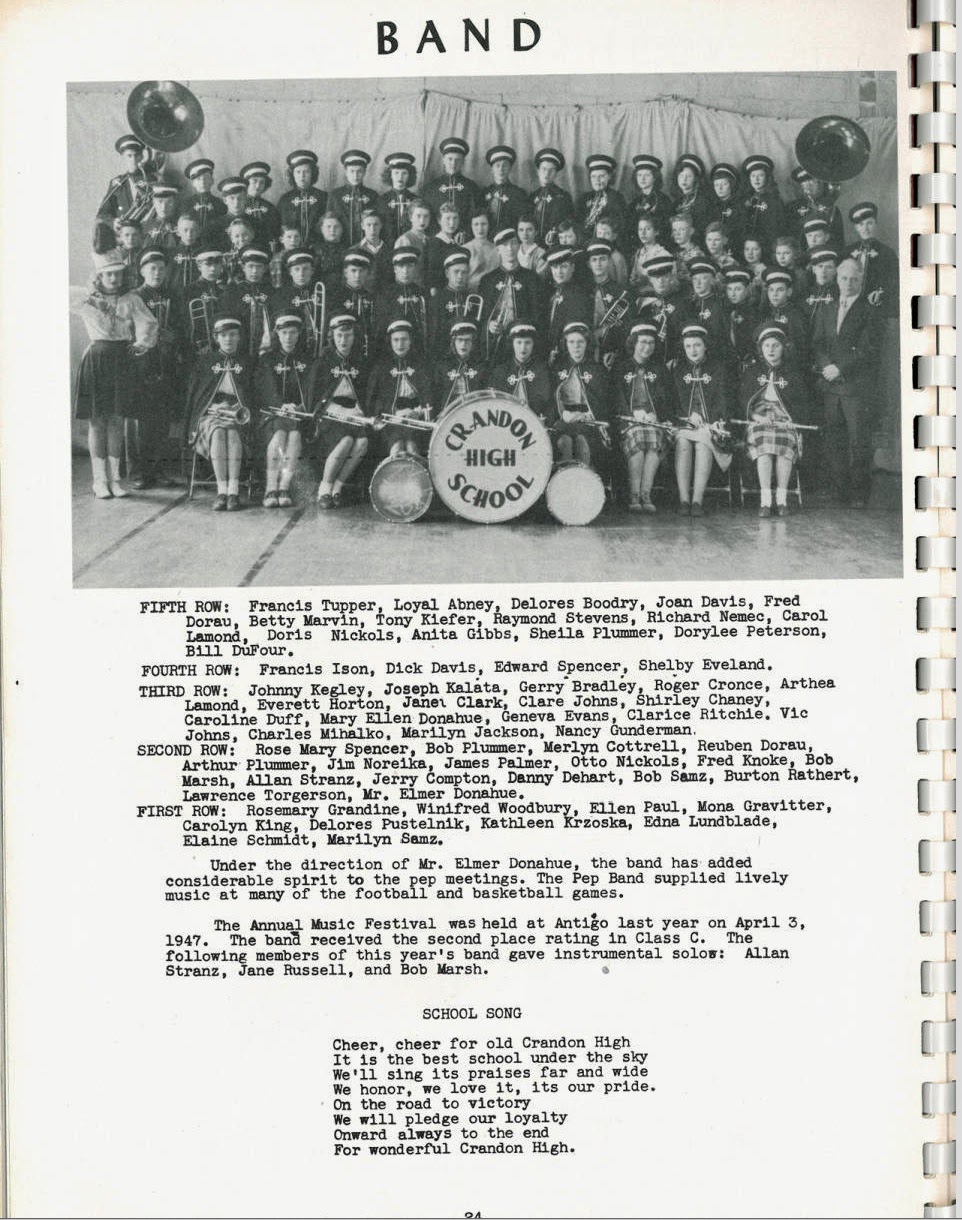
A little nachtmusik...

Here's a fun one. I actually found this picture last fall and while cleaning out my iPhoto image library was reminded that I had it.

My dad and his sisters attended the Crandon, Wisconsin school system when they were younger. The county library has been digitizing their yearbooks from the schools. This image popped up during one of my searches:


It is of interest because my Aunt Claire is in this picture. She is in the third row from the bottom about in the middle of the line. I never knew she was musically inclined.


Wednesday, May 7, 2014

A little spit goes a long way...

This week FamilyTreeDNA announced their new 'myOrigins' which is, according to their website, the new version of their DNA Population Finder. This is the test that gives you your ethnic makeup. If you had the FamilyFinder test done previously, then you will automatically see the new results. Apparently they have updated their database, so the percentages and breakdowns of one's results, in some cases, will have changed slightly.

I have already seen one change, the 5% JOHN result that had Palestinian/Jewish/Bedouin is no longer there. But now I see Spanish/Italian/Greek in the mix instead, which is also seen with William Shepard's results. Interestingly Bill has a slight bit of Middle Eastern showing up now, and no Germanic whatsoever. I highly suggest you click on the images to see them larger.

Vic's results show very little of his German ancestry, but lots of his mother's Norwegian and, possibly, George Hamm's unknown father's Northern Mediterranean heritage, (which probably showed up as the Jewish background before the update). There is also a bit of the JOHN's Trans-Ural Plains.

Bill has mostly English/Irish/Scottish with good percentage of Northern Mediterranean thrown in, and that smudge of Middle Eastern, maybe the latter two came from the Roman empire's invasion of the British Isles.

For myself, it looks like I got mostly the German DNA with about equal amounts Irish/English/Scottish and Norwegian. The surprise for me is seeing the Finnish added in the mix with our Norwegian, although I am not sure why I should be surprised.

Now for those Bumann relatives. No surprise here, with a guy who is half German and half Polish, these results were pretty well expected.

I didn't put Robert Cain's results on here because he is only related to us on one side of his family, the Cain side, so I don't know what part of the results would be from his mother and what part his father.

Personally I find the new way of presenting the data very organic and more comprehensive, also colorful. And as purple is my favorite color, I am glad to see lots of it on the maps, even if it's not on mine.

The study of the origins of the human race has always been of interest to me. As far back as high school I was most interested in those classes that taught DNA and Anthropology. Reading about the breakthroughs in science, that are helping us understand where we come from, has been a fascinating journey these last few years. And it seems that more and more of these breakthroughs are coming out everyday. I am glad that I am able to participate in the ride and I thank those of you who have joined me by donating your spit.

Science Rocks!


Wednesday, February 19, 2014

A little corner shop

Brooks' former store, King Street is the one going off to the left in the picture, Pine Street is the one going off to the right.
Sometime around 1855 Almira and John Brooks headed on over to Burlington, Vermont to live. At this time I am not sure exactly when the Brooks started their store in Burlington, but I do know that by 1868 they were living and working at this address which was called 'corner of King and Pine' it didn't have an exact address until sometime between 1872-1882. In this picture it is currently clad in hideous vinyl. It would be nice to see it in its original dress. According to records in 1890 Almira is the owner of the building, and John is still alive. He didn't pass until 1898. So now the question is why is she the owner of the building and not both of them. Hmmm. Inheritance? She also owed the building next door at 176/178 Pine Street. Which I believe they lived in or used as a home at one time  or another.

The Historic Burlington: University of Vermont website describes the house as:
"This 2 1/2 story, wood frame building, which is clad in vinyl siding and has a pyramidal, slate-clad roof and a 2-story octagonal oriel on its northwest corner, was probably built between 1877 and 1886, although it may be of an earlier date."
The family actually lived at 79/81 King Street for a year or two, according to city directories. Which is part of the building, see the door off towards the left with the small awning. According to the Historic Burlington: University of Vermont website a birdseye view of Burlington in 1877, apparently, clearly shows no buildings at that location, and the 'massing' of the 79/81 King Street building make it doubtful that is was built in the 1860s. I am not sure what we can say about that other than land records would likely clear the matter up along with tax rolls. The address would be considered 174 Pine Street if one numbered it from that side of the streets.

The building was used as a commercial business for a large portion of its life, the lower part being used as a shop of some kind or other, the top being used as apartment rentals. It wasn't until sometime after the 1970s that the bottom was boarded up.

You can still see the building using google street view. Not very pretty, but it is one of the few remaining older buildings in the town.

I even have an update.

In looking over the website mentioned above, I found two plat maps that have the home listed on them. Which is curious because according to the University's research the building isn't there in the 1877 birdseye view map. That may be so, but it shows up on these two:

This plat is from 1853. The family is probably not living here at the time, but as you can see the building is there on the corner of King and Pine.

This map is from 1869. The family is definitely there now, as can be plainly seen by the J. Brooks entry on the map.

The building as it looked in 1933 just barely in the picture on the left edge of image.


Friday, February 14, 2014

That tiny 5%...


Not too long ago I posted an entry talking about the results of my Dad's upgraded DNA tests. In it I mentioned the fact that his FamilyFinder results (ethnic background) indicated 95% Western European and 5% Palestinian, Adygei, Bedouin, Bedouin South, Druze, Iranian, Jewish, Mozabite.

Wow that's a mouthful.

As I heard nothing from anyone in the family about this information, I can only assume that no one really understood the significance of this find. So let me clear the matter up in layman's terms. Here is a simple chart:


The 'SELF' in this particular case is my Dad. The chart shows what percentage of DNA he is inheriting from each generation of grandparent. So this means that he inherited his 5% from somewhere in the 2nd to 3rd generation back in the family tree.

So if I look at the family tree chart, some lines can automatically be eliminated: Irish, Norwegian, in America for 200 hundred years. Basically it boils down to either someone in the John/Deadrich line or someone in the Hamm/Isserstedt line. My money is on George Hamm's unknown father. Remember, he was illegitimate, his surname at birth was his mother's KNOBLOCH. So we do not know who his father is, and probably never will. (Unless I can find a George Hamm descendant willing to contribute to the DNA pool.)

My theory, admittedly it is pretty sketchy, is that Elizabeth Knobloch had a romantic love affair with a Jewish gentleman and they were not allowed to marry because of the religious differences. But theories aside folks, what this means is that my siblings and I, and my cousins on the John side of the family have 100% Jewish/Palestinian ancestors.

The surname lines of interest are: JOHN, DEADRICH, SCHULE, SCHULZ, ISSERSTEDT, SACHS, NEHRBOSS, KNOBLOCH, Unknown father of George HAMM

This map shows the areas of origin for Dad's results.
I hope folks will now appreciate the significance of this information. I myself am fascinated and look forward to more refined tests in the future.

Monday, December 9, 2013

Pay attention...

It's not that I am unsure of the connection of Kari Jorgina Johnson to John Stianson and Kari Gunlichsdatter, the evidence and coincidences are too many to be in doubt, but in researching Jorgina and her family, I have yet to find a definitive document that specifically connects Jorgina Johnson Amundson to who I believe to be her parents. The marriage record and her death record both give a good record of a connection, but her father's surname is hard to read and her mother's name is wrong on her death record, and neither of her parents or Amund's are listed on the marriage certificate, but her last name of Johnson helps push the connection to the yes category, as does the fact that her birth is the same as the Jorgina born in Norway to this family. When doing genealogical research the preponderance of the evidence is usually enough to prove a connection. So in order to cover all my bases, I am still looking for more evidence.

I have filled in most of the gaps of Jorgina's sibling's families using the Holden Church and online Norwegian records, and I was trying to think of another record that might help in that regard. That's when I smacked myself on the head when I realized that the marriage certificate has witnesses listed.


And there was the fourth connection that says yes to Jorgina being the daughter of John Stianson and Kari Gunlichsdatter - H. Einertson and E. Halvorson are the witnesses to her marriage. H. Einertson is her sister Ingaborg's husband - Halvor, (E. Halvorson is possibly her cousin, a son of Ingaborg and Halvor, I'm not really sure yet).

I am still trying to find a church record for Jorgina and Amund's marriage. I might have to wait until I get to Salt Lake City to look at the Lutheran Church records on microfilm there. But maybe an email to a good source before then will answer the question unequivocally.

Friday, September 6, 2013

Upgrade...

I mentioned a few months ago that I was doing an upgrade to Dad's DNA tests, as FamilyTreeDNA was having a sale. Well I finally got the results last weekend. I waited until Labor Day weekend to share them with Dad as we were going to be there for a visit.

The upgraded tests were for his mtDNA, being Myrtle's female line, and the Family Finder test. The Family Finder test finds cousins in the FamilyTreeDNA database and your percentage of ethnicity. In mine and grandpa Shepard's Family Finder results we carry the DNA that shows us to be 100% European. Imagine my surprise, when Dad's showed up with 5% Palestinian, Jewish, Druze, and Bedouin. I should correct that to be surprised, but not surprised. I imagine that the JOHN DNA is what carries these characteristics, as the ancient  JOHN yDNA has its origins in the Middle East glancing into Asia.

The reason none of this DNA showed up in me is all about chaos. My burning question now is which side do I choose?


Monday, July 1, 2013

Drowning in Brooks...

Almyra Brooks
Okay, it was a bad pun. But when you have a surname like Brooks in your family you have to have a little fun with it.

I have been doing a lot of research on Almyra Brooks' family. Why? Because she is one of those women's lines that has been pushed to the side in other people's research because it required a little too much effort to figure them out.

But not me. I am very persistent and tenacious when it comes to these kinds of puzzles, and I love a good challenge.

When I started this research all I knew about Almyra's parents was mostly just their names and a few other details. So what have I been able to find out so far? Almyra's father John, jr. was born in Albany, Albany County, New York a week after his father John, sr. died of illness in the Buffalo area of the state (after having joined the Army to fight in the 'War of 1812'). John, jr.'s mother, Diana Smith Brooks (who was born in England), was left with five children to raise on her own. The eldest of those children was Peter, and he was not even her own. Peter was born during what I am quite sure was John's first marriage. What's that you say, John Brooks, sr. had a previous marriage? Oh yeah. And I am the one who figured it out.

The guardianship file for John Brooks, sr. indicates all the children along with their ages. Using a wonderful device called a calculator, I was able to figure out that Peter was born before Diana and John were married, a good indication that John was married previously to Diana. The guardianship case also named a Peter Brooks, Diana's brother-in-law, as guardian. So not only do I now have the names of all the children of John, sr., I have a brother for him too.

While in Salt Lake City, I looked at a film of burial records of the Dutch Reformed Church in Albany on the off chance it might have something of interest for me. I found two intriguing records. One was 'John Brooks' child' burial costs and the date of August 1802, the other one was an entry for 'John Brooks' wife', burial costs and a date of October 1805. These entries were intriguing because of the dates, both of which were before John married Diana in 1807 which strongly suggested a connection. So I made note of the entries.

When I came home and started going through my research data, I looked over the above records and decided to check other online databases of the Reformed Dutch Church records. I found three very interesting entries in the marriage and baptismal records. The first was a marriage for a John Broocks to a Hannah Groesbeck in 1801. The second was the baptism of a daughter Elizabeth in 1802. The last and in my mind most convincing evidence that this marriage was my John, sr.'s first one, was a baptism for a Peter in 1804, the same year that the eldest son Peter was born.

Put together with what I already know, I am convinced that John's first wife was Hannah, they had a daughter Elizabeth who died at a few months of age, and then had a son Peter. Hannah died about 10 months after Peter's birth. John then married Diana. They named their first born Elizabeth after John's first daughter.

So my next question is, who are the parents of John, sr. and Peter Brooks?

The best source would be the same Dutch Church records I looked at previously online. These records along with a website dedicated to the history of Albany have given me information that makes me lean towards the theory that John Brooks b1783-d1815, brother to Peter Brooks b1780-d1825 are both the sons of Peter Brooks and Frances Wendell. I know Peter and Frances had a child named Peter, as I found a baptismal record for one in 1780. John Brooks named his eldest Peter. John had a brother named Peter. (There are not a bountiful amount of Peter Brooks in the directories or census records.)

If indeed this connection is true, it has been indicated that Peter Brooks who married Francis Wendell in 1772, was the son of Jonathan Brooks and possibly Rebecca Tatten, (Jonathan's will names his wife Elizabeth, so I am unclear about this information). Jonathan is considered the patriarch of the Brooks of early Albany.

There is still research to do on this line, but it is starting to look up. It is still unclear if the Brooks are of Dutch or English descent. But I am looking forward to finding out.


Friday, June 28, 2013

All about John...

No this is not a post about the John family. This is a post about John GEORGE.

In going about my research on the GEORGE family, (that would be in relation to Grandma Dick's grandmother Rachel GEORGE), it appears that William GEORGE and his wife Margaret arrived in Tyler County, Virginia in the late 1700s to early 1800s. Don't know exactly yet. They had at least 4 children, although I might have found a fifth - but that is another story. The only one of their children I could find no information on online was John GEORGE.

Now John is not a direct ancestor, but a 5g Uncle. Which doesn't matter to me, because I research all my relatives, if possible, as I have mentioned in earlier posts. In this case it was just a matter of curiosity. What the heck happened to John? Why does no one have anything on him online?

So commenced my hunt.

My first major puzzle piece was a land record in Tyler County, and because John was selling land, his wife's name had to be listed. Diadamia. What a lovely name. This was the first tidbit I had found of his wife.

The last major puzzle piece, that pretty much put the picture together, was another land record. This one was recorded in Tyler County, but it had been sent from Elkhart County, Indiana in 1838. Wow! Major news. So my next move was to check all the census records for Tyler County for the GEORGES and make a list of who was living there as early as I could find them. John has moved out of his parents home and was living with his wife by 1810, he was about 26-29 years of age. So according to the census' and the above land record they stayed in the area until sometime between June of 1838 and September of 1839, which is when they moved to Indiana. This find was confirmed with census records in the area of Elkhart County.

John died by 1846. I know this because in searching the Indiana vital records online for information on the children, I found a record of his wife having married a Kinsey in 1846. Diadamia and her new husband are found together in 1850 in Elkhart, but by 1860 Diadamia had also died (confirmed by census records).

I know of at least 4 children for the couple: John, William, Elizabeth, and Cassandra. Elizabeth and Cassandra each had married in Virginia, the former to a Jacob Sailor, and the latter to a Lewis Pitts. They had traveled with their parents and their own families to the wilds of Indiana. Eventually, the Pitts family traveled on to Nebraska which is where Cassandra died. Elizabeth's family stayed in Elkhart. I do not know what happened to John or William yet, and I might or might not pursue their whereabouts.

So I have pretty much solved the mystery of John GEORGE. I am sure there are more records in Indiana that could give me even more information on the family, but that can wait for another time. So many surnames so little....well you know.


Tuesday, June 25, 2013

Improvements in transcriptions...

Ancestry.com has a database on their site of Hamburg passenger lists. That would be those people leaving Germany from the port of Hamburg. Recently there has been an update to the database which includes an index of the records from 1850 to about 1890, I think, anyway is covers the dates I need. The great thing about this index is that it is the Archives in Germany that is doing it. Which means that the information from the transcription will be more accurate.

In my case, I was hoping to see a refinement of the entry for  Frederick William John and Henrietta Volk in the records. Which I did. The transcription confirmed that which I believed to be true, but wasn't quite sure of, F W John and his wife Henrietta both indicated that they were born in Altraden, Posen, Prussia.

It's not ground breaking news, but it makes me feel better about including the information in my own records. FW's brother August did not have to give the same information when he emigrated in 1855, he only had to say where he was from, that could just mean where he last lived. We have that information.

At this time there are very few accessible records for Altraden for me to look at. I do keep checking up on Posen websites as there are a few indexing projects going on from church records, but it might be a while before we find anything, if ever.

Wednesday, December 19, 2012

Postmaster in the house...

The JOHN family has a few postmasters in its background. This position was due to two of our ancestors working with the rail system, Frederick William in Gillett and Victor Hugo in Wabeno and the surrounding area. Victor was in fact station agent in Wabeno for many years.

Ancestry.com just this week uploaded their postmaster appointment database with image and I decided to look for both of the above named gentlemen. The top image is FW John's appointment and the bottom image is Victor Hugo's (just click on the images to see a larger version). Here is a description of the collection from Ancestry:

This is a database of post office appointments stretching from 1832 until 1971. The records are mostly a register of people appointed to run post offices, but opening and closing of post offices, as well as Presidential appointments and Senate confirmations are included. The records primarily include name, appointment date, vacancy cause, vacancy date, post office location, state, county, and volume.


I looked for William A. Shepard in the database, but did not find him.

Saturday, April 7, 2012

Great expectations...

Well it finally arrived. The 1940 census, 72 years after the fact.

Day one of research - total server meltdown. After a few hours I just said fugetaboudit. Day two - better luck, I managed to acquire a couple of records. Day three - much better access, found a few more records and only a few more to go. By Friday I had pretty much found all the records I will be able to. The only missing one is of course, Fred Hamm, my wandering vagabond.

So for your viewing pleasure the 1940 census for Clarence and Mytle John:


This census shows Clarence, Myrtle, Claire, Victor and Carol all living in Laona, Wisconsin. My one hope for this record was to see if Clarence was listed as having worked for one of the Government programs like the WPA or CCC, unfortunately there is just a dash in the box. Clarence was also one of the two people on a page that were asked extra questions in this particular census. The only item of interest to me was his occupation was listed as forestry and government work. So maybe because he wasn't one of the unemployed men working for the WPA or CCC, he isn't listed as working for either program, even though he was but in a different capacity.

Next is William and Lois Shepard:


In this census you can see that Lois and William are living with William's parent's William and Rachel in Genoa Township, Delaware County, Ohio. This is just north of the Westerville area. None of the Shepard children are born yet, looks like we will have to wait another 10 years for the next census.

So I am pretty much done looking for relatives in this census. Carrie Cain is still around as is Eliza Hays. I even found Emil Hamm in Duluth, while looking for Carrie/Kari Amundson. Fred Hamm is my only fly in the ointment. I checked the complete census for Shawano County,Wisconsin as that was his last place of residence in the 1930 census, but that was a bust. No surprise there. Looks like I will have to wait for the indexing to be done.


Saturday, March 24, 2012

It all started with a membership to NEHGS

My grandmother Lois Shaw comes from a long line of New Englanders, many of whom arrived in the new world in the 1600s. So when the New England Historical and Genealogical Society (NEHGS) had a sale on membership last fall, I thought it would be prudent to join.

The Shaw book that was put out by Evelyn Shaw Mason in 1997 for the reunion, has a good amount of information in it on our Shaw family. But some lines, usually the female ones, were not pursued at length.  One of those lines is Almyra BROOKS', a family I have been trying to learn more about for quite a while now. A few months ago I decided to use the NEHGS site to check into my BROOKS who hailed from Albany, Albany County, New York before moving to Burlington, Vermont in the 1860s.

I knew that Almyra's paternal grandparents John Brooks and Diana Smith were married in Albany, Albany County, New York in 1807, I had the church record to prove it. But that was about all I knew about them. Well that, and the fact that Diana Smith was born in England. From previous research I had also deduced that Almyra's father John had a brother David, a tinsmith, who moved his family to Cherry Valley, Otsego County, NY.

So off I went to the NEHGS search engine looking for Brooks in Albany. My first find was a major one. It was an abstract from a probate record for a John Brooks dated 1817. In it was a list of the following children: Peter, b. 1804, Elizabeth, b. 1808, Thomas b. 1809, David b. 1812, and John b. 1815. John's widow, Diana, was being granted guardianship of the children, along with her brother-in-law Peter Brooks.

Wow. This was a great find and that one little abstract told me a lot. First it told me this is the John I am looking for. This information was confirmed by the widow's name being Diana, and the last two children being David and John, both born exactly as my previous research had indicated. The probate also mentioned one other very important item of interest. John was in the US Army. The light bulb that went off in my head said War of 1812.

My next step was to see if I could find a War of 1812 pension record for John and I did. Diana Little, his widow was the applicant. This has to be the Diana I was looking for, the coincidence was too great to pass up. So I ordered the pension file and it arrived three weeks later.

This is what the pension file told me: John Brooks died 31 May 1815 at Black Rock, NY of disease. Black Rock was a naval port during the war of 1812, and is now part of Buffalo, NY. He had enlisted in the US Army 4th Rifles on March 30, 1814 for a term of 5 years. As the war ended in December of that year, he probably participated in a few engagements with the British.

One curious bit of information from the abstract was the fact that the eldest son Peter was born about 1804, which is before John and Diana were married. So was Peter their son, or was John married before Diana? According to Diana she had lived in Albany for about 54 years, before that she was living in New Scotland, NY which is not far from Albany. So maybe New Scotland had records of interest and that is where John and Diana met.

Diana married Robert Little about 1817/18. Robert died in an almshouse in 1845, which could mean he was infirm in some way, an alcoholic, or mentally unstable. Diana/Dinah was living on her own for quite a while as can be seen in the census records. She eventually ends up in the household of William and Jane Cassidy - Jane might be a daughter she had with Robert, as she was born about 1818.

Diana, born in 1785 in England and died 11 April 1872 in Albany. She is buried in the Cassidy family plot.

I still don't know where in England Diana hails from or who her parents are. But I do know a little more about her than I did before. The same goes for John Brooks. John could be a descendant of the Brooks of Massachusetts or the Dutch Brooks of Albany. There is still a bit of mystery left. But at least I now know he had a brother Peter.

One last interesting bit of information I found in the pension file was a letter sent by a women researching her Brooks family and hailing from Burlington, Vermont. She is a descendant of our John and Almyra of Vermont. Using this information I have found a living relative still in Burlington. I will be sending a letter this week.

Friday, July 30, 2010

In my travels...

A week or so ago, Dale and I headed up north to White Lake, Wisconsin for a memorial service for one of his Aunts. After the service we were talking to his cousin Jane and she reminded us that the Depot Museum was open. So we decided to stop in for a look-see, especially as we donate to the museum to help keep it open.

Now my particular interest in going was a recent find in my V. H. and Gertrude John research that they lived in White Lake for at least 4 years. While there Victor was a cashier at the White Lake State Bank which he helped to start, probably due to the opening of the While Lake Mill, part of the Yawkey Bissell lumber industry. The Johns most likely knew the Yawkeys and Bissells when they lived in Wabeno in the early 1900s.

Dale didn't believe me when I told him about the bank. But of course I insisted that it was so. A fact which was confirmed when we went to the museum and in the last room near the exit, nicely framed on the wall, was the official government document allowing the White Lake State Bank to start operating, with the date of 1921, a date which corresponds with my research perfectly. It was a very fun and unexpected find.

Friday, July 23, 2010

My first blog...

Well folks to make it easier to keep everyone interested informed about my research progress on the Shepard and John lines, I have decided to try blogging it. After all, everyone is doing it. So look for some updates heading this way soon.